
Why is my commercial fridge not holding temperature?
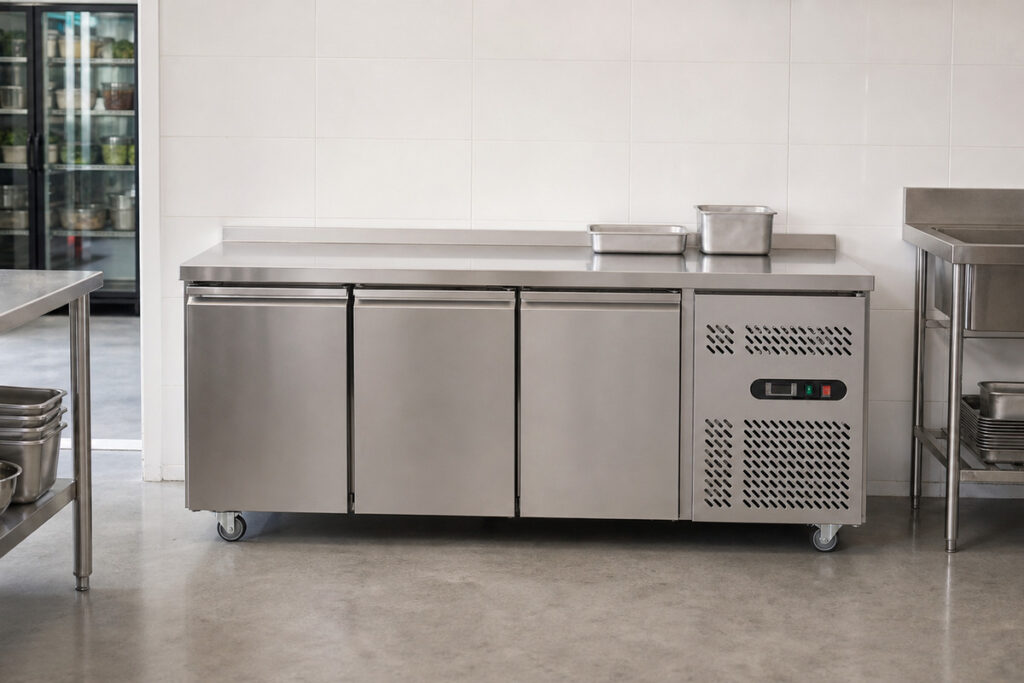
Most “won’t hold temp” calls come down to airflow, defrost or refrigerant. Start with the easy stuff — door seals, packed-in stock, a choked condenser — then look at the compressor, defrost cycle and gas charge. Anything refrigerant-related is a licensed job. If it’s food, don’t wait it out — book commercial fridge repairs in Sydney before stock is at risk.
A commercial fridge or cool room that drifts a few degrees isn’t just an inconvenience — it’s a clock running on your stock and, in food and medical settings, on your compliance. The good news is that most temperature complaints trace back to a handful of causes, and several you can rule out yourself in a couple of minutes with a probe thermometer and a torch.
Below are the six faults we see most often on Sydney callouts, in roughly the order worth checking them. For each: what it actually is, what you can safely check yourself, and the point where it becomes a licensed technician’s job. (If you’d rather skip ahead, our commercial fridge repairs team carries common parts on the van.)
1. It’s “running warm” — the first three things to check
Before assuming a component has failed, confirm the cabinet is really losing temperature and not just being asked to do the impossible. A unit set to 3°C will read warm if it’s been loaded with a trolley of room-temperature stock, if hot product was put in to cool, or if the door has been open during a busy service.
What to check yourself:
- Door seals (gaskets). Close the door on a sheet of paper — if it slides out with no drag, the seal has perished or split. Warm room air leaking in makes the unit run constantly and ice up. Wipe seals clean; replace if cracked or compressed flat.
- Airflow inside. Stock stacked against the back wall or over the internal fan starves the evaporator. Leave a gap around vents. Don’t overfill.
- The set point. Sounds obvious, but a knocked controller or a “defrost-on-demand” button pressed by accident is a genuinely common cause. Confirm the displayed set point matches what you want.
- Ambient heat. A fridge jammed next to an oven, char grill or in a hot back-of-house will struggle. The condenser can’t reject heat into already-hot air.
When to call: If seals are good, airflow is clear, the set point is correct and the cabinet still won’t pull down to temperature, it’s no longer a housekeeping problem — move on to the mechanical causes below.
2. The compressor runs non-stop — or won’t start at all
The compressor is the pump at the heart of the system. Two opposite symptoms both point to it: a unit that runs continuously and never satisfies, or one that’s gone silent and warm.
Runs constantly: usually a sign the system can’t reach set point — often because of a dirty condenser (fault 5), low refrigerant (fault 6), or a heavy heat load. The compressor isn’t faulty so much as fighting a losing battle, but running flat-out 24/7 will shorten its life.
Won’t start / short-cycles: listen for a click-then-hum followed by silence every few minutes. That can be a failed start capacitor or relay, a tripped overload, or a seized compressor. A failed condenser fan motor causes the same overheating shutdown.
What to check yourself: confirm power and that the unit isn’t simply switched to a defrost or stand-by mode. Feel whether the compressor body is extremely hot (overheating) or dead cold (not running). Beyond that, capacitors and electrical testing should be left to a technician — there’s stored charge and mains voltage involved.
When to call: any compressor that hums and trips, won’t start, or runs without ever cooling. This is core commercial refrigeration repair work — we carry common capacitors, relays and fan motors on the van to fix it in one visit where we can.
3. Iced-up evaporator and defrost faults
Open the unit and find the back panel or coil caked in ice or frost? That ice is insulating the evaporator from the air it’s supposed to be chilling — so the cabinet warms up even though the system is working hard. It’s one of the most common “not holding temp” presentations.
A working fridge melts that frost away on a scheduled defrost cycle. When the defrost heater, timer, termination thermostat or controller fails, frost builds with each cycle until it chokes airflow completely.
What to check yourself:
- Manually defrost: switch the unit off, prop the door open, and let all ice melt fully (a few hours). If it then holds temperature for a day or two before icing again, you’ve confirmed a defrost-system fault rather than a one-off.
- Check that frost isn’t coming from a constant air leak — back to door seals and the habit of leaving doors open.
When to call: if it ices up again within days, the defrost heater or control has failed and needs diagnosis. In a walk-in, recurring ice on the coil or floor is also a sign worth a proper cool room service — ice on a freezer-room floor becomes a slip hazard as well as a fault.
4. Water pooling inside or underneath — blocked drain
Water on the cabinet floor or a puddle under the unit usually isn’t a leak in the dramatic sense — it’s defrost melt-water that can’t get away. Every fridge produces condensate; it’s meant to run down a drain line to an evaporation tray. Block that line with food debris, grease or a frozen plug and the water backs up.
What to check yourself: locate the internal drain hole (often at the base of the rear interior) and clear visible debris. A blocked drain frequently sits alongside an icing problem, so check fault 3 too. Make sure the unit is level — a fridge tilted forward sends water out the door instead of down the drain.
When to call: if the line is frozen solid, runs inside a wall or under a cool-room floor, or the water keeps returning after clearing. Standing water near electrics or stock is a hygiene and safety issue you don’t want to leave.
5. A dirty condenser coil — the silent killer
If we had to name the single most common cause of slow temperature loss and premature compressor failure, it’s a condenser coil choked with dust, grease and kitchen lint. The condenser is the radiator that dumps heat out of the system — usually a finned coil at the back or underneath. Block it and the system can’t reject heat, so it runs longer, runs hotter, and slowly stops keeping up. In a grill-heavy kitchen a coil can clog in weeks.
What to check yourself: find the condenser and look at it. If you can’t see metal through the dust, that’s your problem. Power down and gently vacuum or brush the fins (brush in line with them so you don’t bend them). Keep the area around the unit clear so it can breathe.
When to call: if cleaning helps but temperature still drifts, or the coil is impacted with baked-on grease, it needs a proper coil clean and a system check. This is exactly the failure a scheduled refrigeration maintenance plan is designed to prevent — most of our breakdown callouts are units that simply never had the condenser cleaned.
6. Low refrigerant and gas leaks
Refrigerant is the working fluid that carries heat out of the cabinet. A sealed system shouldn’t lose it — so if the charge is low, there’s a leak somewhere. Symptoms include a unit that runs constantly but only gets “cool, not cold”, hissing or bubbling noises, oily residue around joints and fittings, and ice forming on the suction line rather than the evaporator.
What to check yourself: honestly, very little — and that’s deliberate. You can note the symptoms above, but you cannot legally or safely top up refrigerant yourself. Adding gas to a leaking system without finding and fixing the leak is throwing money at the problem, and venting refrigerant is both an environmental offence and a breach of the licensing rules. (We cover this in detail in our guide to what it costs to regas a commercial fridge.)
Handling refrigerant in Australia requires an ARC Refrigerant Handling Licence. Active holds licence L057415. We leak-detect, repair the joint, pull a vacuum and recharge to spec — not just “gas it up” — so the fix actually lasts.
When to stop checking and call a technician
The self-checks above are worth doing — they fix a real share of “warm fridge” calls without a callout. But there’s a point where waiting costs more than the repair, especially when stock or safety is on the line. Call straight away if:
- Food is sitting above 5°C and you can’t bring it down within the hour — that’s the food-safety danger zone, not a maintenance problem.
- You suspect a refrigerant leak (hissing, oily residue, “cool not cold”).
- The compressor hums and trips, or the unit is dead.
- It ices or floods again within days of you clearing it.
- It’s a vaccine, pharmacy or medical fridge — temperature excursions there are governed by the “Strive for 5” guidance and AS 3864, and need data-logged confirmation, not a guess.
A walk-in or freezer room down overnight is stock written off by morning, which is why we run a genuine 24/7 emergency breakdown line across Greater Sydney — you talk to a real technician, not a call centre.
Don’t risk the stock — talk to a licensed Sydney tech.
Frequently asked questions
Why is my commercial fridge running but not cold?
A unit that runs but only stays “cool, not cold” usually points to a dirty condenser coil, a frosted-up evaporator, or low refrigerant from a leak. Check and clean the condenser first; if it’s still not pulling down, it’s a diagnostic job for a technician.
What temperature should a commercial fridge hold?
In NSW, food in a commercial fridge should be kept at 5°C or below, and freezers run frozen at around −18°C. The food-safety danger zone is 5°C to 60°C, so anything sitting above 5°C needs attention quickly. (NSW Food Authority / FSANZ.)
Can I top up the gas in my fridge myself?
No. Handling refrigerant requires an ARC Refrigerant Handling Licence in Australia, and a low charge means there’s a leak that needs finding and fixing — adding gas to a leaking system is wasted money and venting refrigerant is an offence.
Do you do commercial fridge repairs near me?
Yes — we cover commercial fridge repairs right across Greater Sydney, from the Hills District and Western Suburbs through to the Inner West and Eastern Suburbs. We’re same-day where we can and run a real 24/7 line for breakdowns.