
Why is my ice machine not making ice?
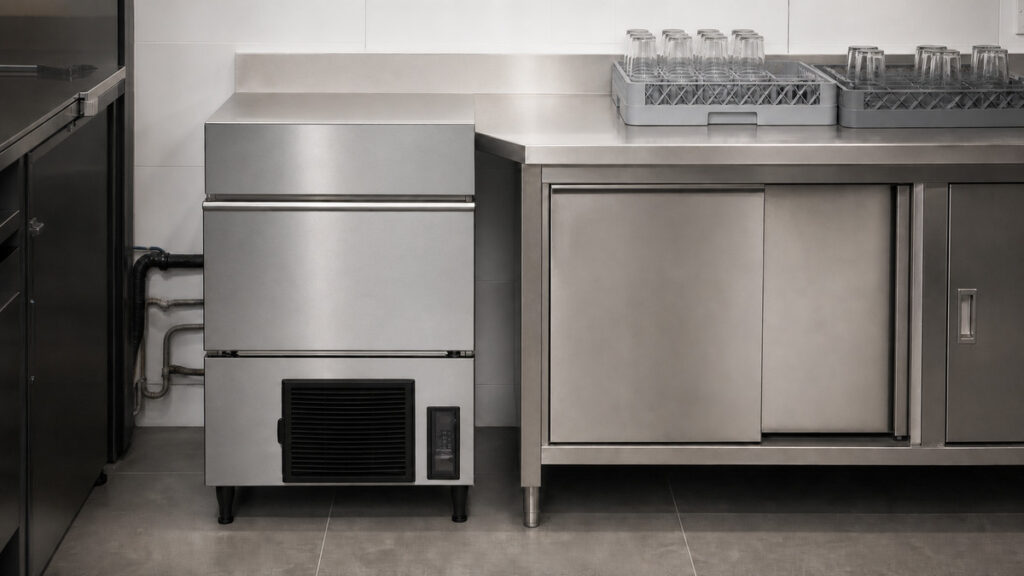
No ice usually means one of five things: no water getting in, scale build-up, a blocked condenser or air filter, a dirty or failed harvest sensor, or low refrigerant. Check the water supply and clean the unit first — then it’s a job for a tech. If you’re stuck, our commercial ice machine repairs in Sydney team covers every major brand.
An ice machine is a small refrigeration system, a water system and a control board all working together — so when it stops producing, the fault is usually in one of those three areas. We see the same handful of causes across every brand we service, whether it’s a Hoshizaki, Scotsman, Manitowoc Ice or Ice-O-Matic. Here they are, roughly in the order worth checking.
1. No water getting in
No water, no ice — so this is always the first check. Confirm the isolation tap to the machine is fully open and that no one turned it off during a clean. Look for a kinked or crushed water line, and check the water filter: a clogged inlet filter chokes supply just like a closed tap. A faulty water inlet valve is a common failure too, but testing that is a technician’s job.
What to check yourself: the supply tap, the line for kinks, and whether a water filter is overdue for a change.
2. Scale build-up — the number-one cause
Sydney water leaves mineral scale (limescale) behind, and an ice machine concentrates it. Over months, scale coats the evaporator and water-distribution parts, insulating them so ice forms slowly, comes out cloudy or undersized, or stops altogether. Scale is comfortably the most common reason a commercial ice machine “just stopped working”.
The fix and the prevention are the same: regular descaling and sanitising. Hoshizaki and Scotsman both recommend cleaning roughly every six months as a guide (more often in a bakery, brewery or hard-water site). Beyond cleaning the cleanable parts, descaling the internal system is best done by a technician with the right food-safe chemicals.
What to check yourself: open the unit — if you can see white, chalky build-up on the evaporator or water trough, scale is your problem.
3. A choked condenser or air filter
Air-cooled ice machines reject heat through a condenser, often behind a removable front air filter. Caked with dust and grease, that filter or condenser stops the machine shedding heat — so it can’t freeze water efficiently and output drops or stops, sometimes with a high-temperature safety cut-out. In a busy kitchen the filter can clog in weeks.
What to check yourself: locate the air filter (usually a clip-out panel at the front), and clean or replace it. Make sure the machine has clearance around it to breathe and isn’t boxed in next to heat.
4. Harvest and sensor faults — thin, slow or no ice
Ice machines run a cycle: freeze a batch, then “harvest” by briefly warming the evaporator so the ice releases into the bin. Sensors and controls manage that timing. When a harvest sensor is fouled with scale or slime, or a control fails, you get classic symptoms — ice that’s too thin, a machine that freezes but won’t drop the ice, or one stuck mid-cycle. A full ice bin with a working bin-level sensor will also (correctly) stop production, so check the bin isn’t simply full or the sensor blocked.
What to check yourself: confirm the bin isn’t full and nothing is blocking the bin-level sensor. Beyond a clean, sensor and control diagnosis is technician work.
5. Low refrigerant
Like any refrigeration system, an ice machine has a sealed refrigerant charge. If it’s low, the machine runs but can’t freeze properly — thin ice, long cycles, or none. As with a fridge, a low charge means a leak, and refrigerant work is licensed in Australia (Active holds ARC licence L057415). This isn’t a DIY check or fix.
6. When to call a technician
The water, scale and air-filter checks above resolve a real share of “no ice” calls. Call a licensed tech when:
- Water supply is fine and the unit is clean, but it still won’t produce.
- You can see heavy scale that needs a full descale and sanitise.
- Ice is thin, cloudy or the machine is stuck mid-cycle — a sensor or control fault.
- You suspect low refrigerant (it’s licensed work — don’t let anyone “just gas it up”).
- It’s a venue where lost ice means lost trade and you need it back fast.
We repair and service every major brand across Sydney — book ice machine repairs and servicing, or for an out-of-hours venue breakdown, our 24/7 emergency line answers to a real technician.
Ice is a food. A machine that isn’t descaled and sanitised on schedule risks slime and biofilm as well as poor output. We service ice machines as part of a planned maintenance plan so they stay clean, compliant and reliable.
Talk to a licensed Sydney tech — every major brand, fast.
Frequently asked questions
What is the most common reason an ice machine stops making ice?
Scale build-up. Sydney’s mineral-rich water leaves limescale that coats the evaporator and water parts, so ice forms slowly or stops. After that, the usual suspects are no water supply, a clogged air filter or condenser, a fouled harvest sensor, and low refrigerant.
How often should a commercial ice machine be cleaned?
As a guide, descale and sanitise roughly every six months — Hoshizaki and Scotsman both recommend around that interval, and more often in a bakery, brewery or hard-water site. Regular cleaning is the single best way to keep output and hygiene up.
Is it worth repairing an ice machine?
Usually yes — most ice machine faults (scaling, a water valve, a sensor, a fan motor) cost far less to repair than to replace. We diagnose first and give you an upfront quote so you can decide repair versus replace with the facts.
Which ice machine brands do you repair?
We repair and service all the major commercial ice machine brands across Sydney, including Hoshizaki, Scotsman, Manitowoc Ice and Ice-O-Matic. We’re an independent ARC-licensed repairer, not a brand agent, and fit quality spare parts — genuine where available, or a manufacturer-approved equivalent.